By Tom O’Connor | September 22, 2026
It’s only been 22 days since the official release of EDRM 2.0, but eDiscovery software vendors are already launching marketing campaigns touting a “massive 80% reduction in pre-review data volume.”
But we all know that EDRM 2.0 is a conceptual framework and standards vocabulary rather than a software tool. The EDRM organization itself makes no programmatic claim that its model directly reduces or deletes data.
Instead, the latest release emphasizes the necessity of aggressive early-stage data reduction and upstream culling before data ever reaches the expensive document review phase.
So Where Does the “80%” Figure Actually Come From?
The widespread industry discussion around an “80% reduction” stems from three distinct operational realities outlined during the framework’s development:
1. Lifecycle Friction & Structural Volume
During the initial conceptual mapping of EDRM 2.0, contributors noted that grouping early-stage activities together addresses roughly 80% of the structural volume and operational friction in an eDiscovery lifecycle.
2. Modern Cloud Data Dominance
Modern enterprise suites, specifically Microsoft 365 and Google Workspace, may account for approximately 80% of modern eDiscovery data volume.
Rather than extracting raw files from native containers, new workflows enable front-end governance and processing natively inside these platforms.
3. Standard Upstream Filtering
Standard technical filtering, such as deduplication and DeNISTing, routinely yields an 80% to 90% reduction in raw dataset volume prior to human review.
So nothing old is new again.
Core Visual & Structural Shifts in EDRM 2.0
The updated EDRM 2.0 model does introduce several key structural shifts aimed at modernizing eDiscovery workflows.
Accounting for Modern Enterprise Scale
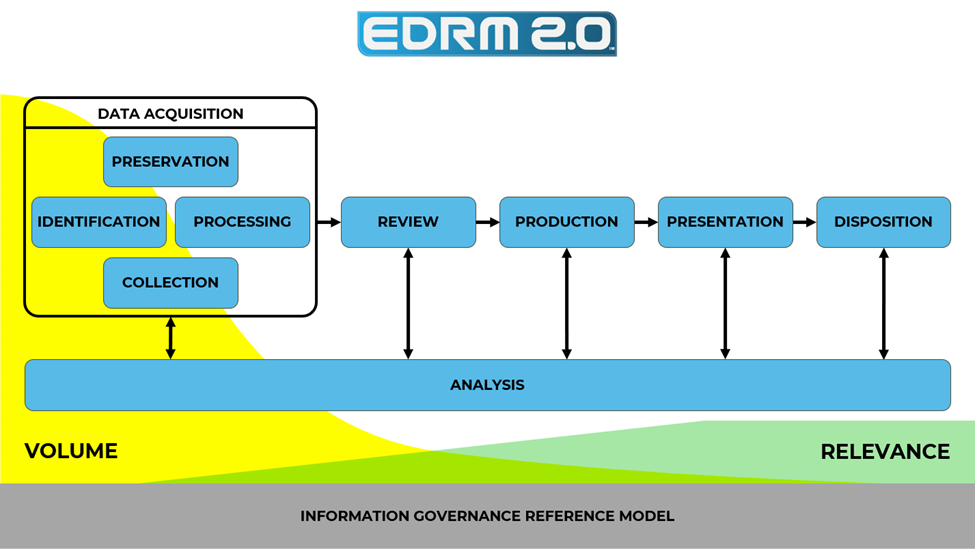
The background curve was redrawn with an exponentially higher starting baseline to reflect massive datasets from collaboration tools such as Slack, Zoom, and enterprise email.
However, this graphic represents qualitative observations and panel discussions rather than an underlying quantitative spreadsheet with specific data points.
Dedicated Data Acquisition Framework
Early-stage activities are consolidated into an integrated Data Acquisition block.
This promotes “in-place” governance behind internal corporate firewalls, helping prevent massive raw data dumps into external review platforms.
The “Left Lean” Movement
The framework shifts technological focus to the left, directing resources toward early noise elimination rather than downstream review pools.
The concept is straightforward: the earlier irrelevant data can be identified and eliminated, the less data ultimately reaches the expensive review stage.
Continuous Analysis Over Linear Pipelines
EDRM 2.0 replaces linear, single-pass searches with Continuous Analysis as a central nexus.
This transforms eDiscovery from a traditional linear process into a more iterative feedback system, where information learned during the process can influence subsequent analysis and decisions.
Vendor Case Studies & Industry Evidence
Prominent eDiscovery providers have been demonstrating data-reduction strategies long before EDRM 2.0.
Logikcull & Twilio
Despite referring to the “EDRM 2.0 volume cliff” in current marketing, Logikcull released a case study in 2022 highlighting how automated deduplication removed roughly 40% of volume, with subsequent filtering eliminating an additional 30%–40%.
The result was an overall reduction of approximately 50% to 70%+ after collection and before review.
In the Twilio example, the company reportedly saved $360,000 in outside legal spend by handling discovery in-house and reducing pre-review data volume by 50% to 70%.
That was in 2022.
Lighthouse & Microsoft
Collaborative case studies involving Technology-Assisted Review (TAR) and purpose-built GenAI solutions deployed upstream have documented reductions approaching 90% in document volume and review costs for enterprise clients such as Microsoft.
In other words, the underlying concept isn’t new.
It is the technology, scale, and emphasis on where those techniques are applied that continue to evolve.
Conclusion
The EDRM 2.0 framework introduces a modernized, non-linear approach to eDiscovery that emphasizes aggressive data reduction and upstream culling.
By utilizing a new Data Acquisition block, the model encourages legal professionals to eliminate irrelevant information by filtering out “noise” early in the lifecycle.
This new conceptual “left lean” in focus prioritizes continuous analysis and early governance to manage the massive scale of modern enterprise communications such as Slack and Zoom.
Ultimately, these developments illustrate a transition from traditional linear workflows to an integrated feedback system that leverages technology to limit downstream data pools.
But every case—and indeed every company—is different.
So before you go looking for an 80% data reduction, talk with your vendor.
Or your friendly local eDiscovery consultant.
Tom O’Connor
September 22, 2026